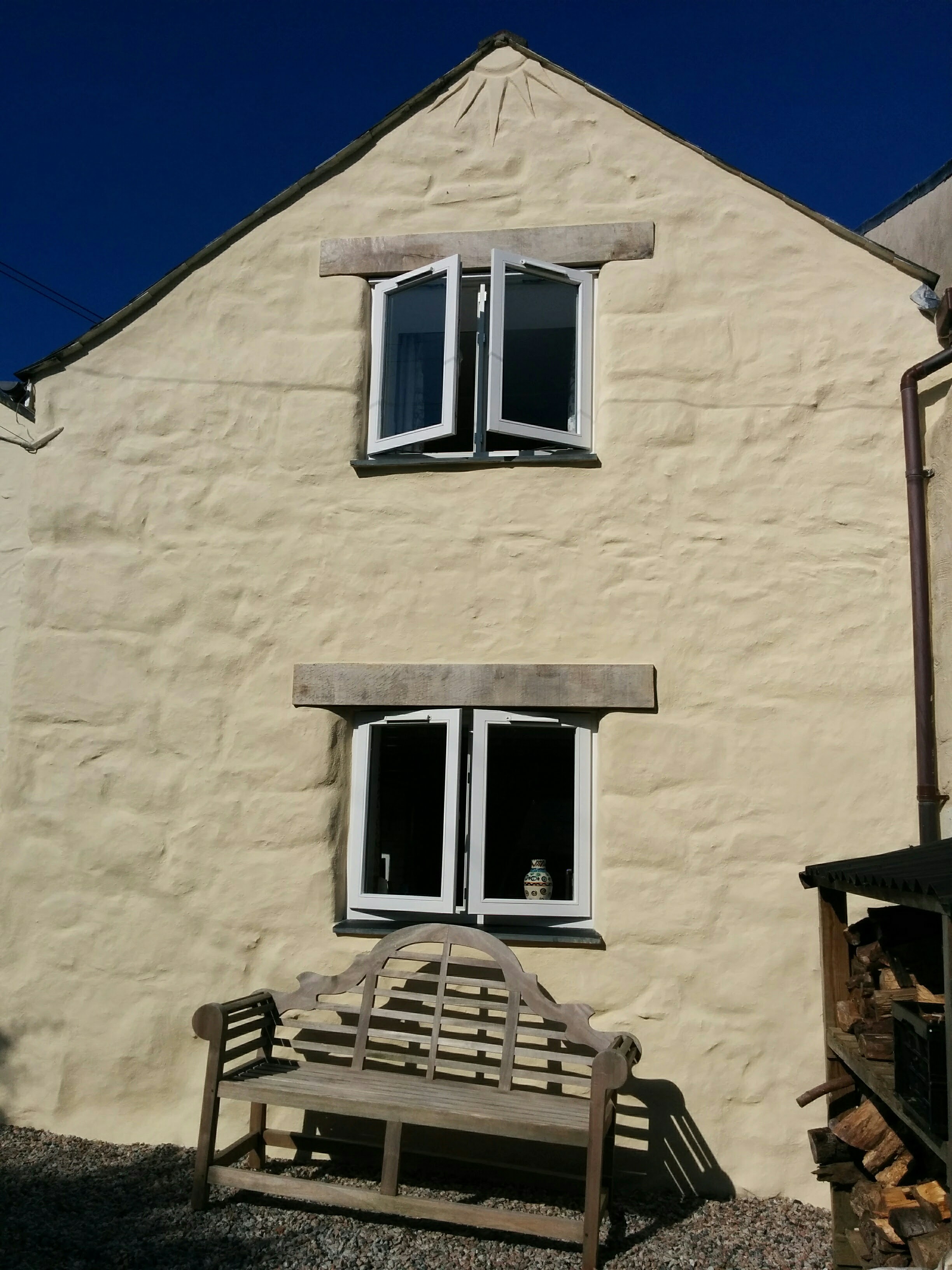
Traditional Cornish Bag Rub Lime Render
At Cornish Lime Builders, we specialise in traditional Cornish bag rub lime render, sometimes referred to as ragging — a distinctive finish with deep roots in the architectural traditions of Cornwall and the wider South West.
Bag rubbing creates a beautifully textured, natural-looking lime finish that is both practical and sympathetic to traditional buildings. It can transform the appearance of a property while allowing the underlying structure to breathe, making it particularly suitable for granite, stone, cob, timber frame and other traditional forms of construction.
We combine traditional materials and craftsmanship with modern application techniques. Wherever appropriate, we spray apply our lime renders using professional Raffina lime spray guns. This allows us to achieve excellent contact with the substrate, consistent coverage and good compaction of the material.
When correctly specified and applied, spray application can also help improve adhesion and reduce the likelihood of shrinkage cracking by allowing the render to be applied efficiently and worked into the substrate.
A finish with deep Cornish roots
The appearance of many Cornish granite buildings today can give the impression that exposed granite was always intended to be the finished exterior.
Historically, this was often not the case.
Across Cornwall, granite and other masonry buildings were frequently rendered, bag rubbed, ragged and limewashed. Exposed stone was not necessarily considered the ideal finished appearance. Lime coatings provided protection from Cornwall’s exceptionally wet and windy climate while creating a softer, more uniform and attractive exterior.
Traditional lime finishes were commonly maintained through periodic limewashing. Limewash and historic milk-based coatings produced a soft, matt appearance while allowing moisture vapour to move through the building.
In other words, the traditional Cornish approach was not simply about decoration.
The finish formed part of the building’s weathering strategy.
Why bag rub works so well on traditional buildings
Traditional buildings were generally designed to manage moisture very differently from modern cavity-wall construction.
Granite, cob, stone, lime mortar and timber-framed buildings can all rely on the ability of their materials to absorb, redistribute and release moisture.
Covering these structures with dense cement renders, impermeable paints or inappropriate waterproofing systems can interfere with this natural process.
This is one reason we so often encounter damp problems following inappropriate modern repairs.
Cement pointing and cement render may initially appear strong and weather-resistant, but on an old building they can restrict the movement of moisture through the wall. Water can then become trapped within the masonry, potentially contributing to dampness, salt damage, frost damage and deterioration of softer historic materials.
The answer is not necessarily to seal the building even further.
We believe the better approach is to understand where the moisture is coming from, how the building was originally designed to deal with it, and then restore that ability wherever possible.
More than simply covering imperfections
One of the great practical advantages of bag rub render is its ability to provide a beautiful and sympathetic finish while accommodating the irregularities often found in older buildings.
It can be particularly useful where a building has:
- Previously botched opening infills
- Damaged or mismatched stonework
- Cement lintels
- Blockwork extensions
- Cob repairs
- Uneven or mixed masonry
- Areas of previous alteration
- Modern additions that need visually integrating with an older building
- Mixed historic and modern substrates
Bag rub can allow these different elements to be brought together beneath a unified lime finish without unnecessarily replacing sound historic fabric.
Rather than trying to make an old building behave like a modern one, a properly designed lime-render system works with the character, movement and moisture behaviour of the existing structure.
Suitable for far more than Cornish cottages
Although bag rub has particularly strong associations with traditional Cornish granite buildings, it is by no means restricted to cottages.
We use lime-render systems on a wide variety of structures, including:
Granite and stone buildings · Cob buildings · Manor houses · Farmhouses · Churches and historic buildings · Timber-frame structures · Lime-render boards · Traditional extensions · Modern extensions · New builds · Buildings designed around breathable construction
Lime can be particularly effective on cob and timber-frame buildings, where compatibility between the render and the underlying structure is essential.
We can also work with appropriate render boards and lime-render boards where traditional materials need to be incorporated into modern construction or where internal and external wall build-ups have been designed to retain breathability.
With cob, timber frame and other traditionally constructed buildings, the entire wall build-up needs to be considered rather than treating the render as an isolated decorative finish.
Spray-applied lime render using Raffina equipment
Our use of professional Raffina lime spray guns allows us to combine traditional lime materials with an efficient modern application technique.
Spraying the lime onto the correctly prepared substrate gives the material excellent contact with the surface and allows us to build the render system up in controlled coats.
Depending on the building and specification, the advantages can include:
- Improved adhesion to correctly prepared substrates
- Consistent application
- Good compaction of the render
- Efficient coverage of large elevations
- The ability to work lime into irregular masonry
- Reduced reliance on excessive mechanical keying
- Reduced shrinkage and cracking when the correct mix, thickness, curing conditions and application sequence are used
Spraying does not replace traditional craftsmanship.
The skill remains in understanding the building, preparing the substrate, selecting the correct lime and aggregate, controlling the thickness and knowing how and when the material should be worked.
The machine is simply another tool in the hands of an experienced lime craftsman.
A breathable alternative to cement rendering
We regularly hear from homeowners whose damp problems have become worse after traditional masonry has been repointed or rendered with cement.
The response can then be to introduce tanking systems, waterproof coatings or impermeable paints internally in an attempt to prevent the visible symptoms.
This can sometimes result in a building becoming progressively more sealed.
Rather than simply treating the symptoms, we prefer to investigate the building as a whole.
That may involve looking at:
- Roofs and rainwater goods
- Gutters and downpipes
- External pointing
- Lime render
- Ground levels
- Drainage
- Water ingress
- Splashback
- Internal ventilation
- Heating and condensation
- Existing impermeable coatings
- Previous cement repairs
Where appropriate, improvements such as French drains and other drainage measures, together with controlled ventilation or heat-recovery ventilation systems, can form part of a wider moisture-management strategy.
Every building is different, and there is no single treatment that will cure every damp problem.
The important thing is to identify the source and pathway of the moisture before deciding how the building should be repaired.
A hydrophobic mineral finish after the lime has cured
Once the bag rub lime render has fully cured, we will often recommend a tinted hydrophobic mineral coating, such as Beeck Beeckacil, where the building, substrate and exposure conditions make this appropriate.
The purpose is not to seal the building in plastic or create an impermeable waterproof barrier.
Instead, a correctly specified mineral coating can provide the external surface with a hydrophobic, water-repellent finish while retaining vapour permeability.
This can be particularly valuable in Cornwall, where buildings are exposed to driving rain, strong winds and prolonged periods of wet weather.
The coating helps reduce the amount of liquid rainwater being absorbed into the external render while still allowing moisture vapour within the wall to migrate outward.
In this way, the lime render can continue to perform its important role in managing moisture without unnecessarily trapping water within the structure.
We generally recommend allowing the lime render to fully cure before applying the mineral coating, giving the lime sufficient time to carbonate and develop its strength.
Why use a tinted mineral coating?
A tinted mineral coating also gives us the opportunity to recreate the soft, unified appearance traditionally associated with limewashed Cornish buildings while providing greater durability and reduced maintenance compared with repeatedly applying limewash.
The result can be a finish that is:
- Water-repellent
- Vapour permeable
- Mineral based
- Compatible with appropriately specified lime render
- Available in a range of traditional and contemporary colours
- Well suited to exposed coastal environments
- More durable and lower maintenance than conventional limewash
For us, this distinction is extremely important.
The objective is not to waterproof the building by sealing it shut. It is to manage water at the external surface while allowing the building to continue to breathe.
As with all lime work, the coating needs to be considered as part of the complete wall construction. We assess the substrate, existing finishes, exposure, moisture conditions and particular requirements of the building before recommending a coating system.
Traditional appearance with modern performance
Historically, many Cornish buildings were maintained through regular limewashing. Lime, casein and linseed oil were among the materials used in historic coating systems, producing a soft and protective finish that was renewed periodically.
Today, modern mineral coatings give us another option.
Where appropriate, a tinted hydrophobic mineral finish can provide the appearance and mineral character of a traditional limewashed building while significantly extending the maintenance cycle.
This means that a client can retain the soft, traditional appearance of a lime-rendered Cornish building without necessarily committing to the frequent maintenance associated with conventional limewash.
Lime render should work with the building — not against it
At Cornish Lime Builders, we don’t see lime render simply as a decorative coating.
A successful render is part of the building’s overall construction, weather protection and moisture-management system.
Our approach combines traditional Cornish building knowledge, modern spray-application techniques and more than 20 years of practical experience working with lime, stone, cob and historic buildings.
Whether we are restoring a centuries-old granite cottage, rendering a cob farmhouse, protecting a timber-framed building, working on a manor house or church, integrating a modern extension, or applying a breathable render system to a new build, our aim remains the same:
To create a beautiful, durable finish that is sympathetic to the building, compatible with its construction and capable of standing up to Cornwall’s demanding climate.
We believe the best restoration work does not simply make an old building look traditional.
It respects the way the building was designed to work.
Traditional materials. Modern techniques. Genuine craftsmanship.
At Cornish Lime Builders, we combine the knowledge of traditional Cornish construction with modern methods and equipment to deliver lime work that is beautiful, durable and appropriate to the building.
From granite cottages and cob farmhouses to manor houses, churches, timber-frame buildings and new construction — we believe lime should work with the building, not against it.